Mean, Median, Mode
These are measures of central tendency. They tell us the "center" or typical value of a dataset.
Mean (Average) is the sum of all values divided by the number of values. It uses every observation, so it is very useful, but it can be affected by extreme values.
Median is the middle value after arranging the data in order. If there are two middle values, median is their average. It is more stable when there are outliers.
Mode is the value that occurs most frequently. A dataset can have one mode, more than one mode, or no mode (if no value repeats).
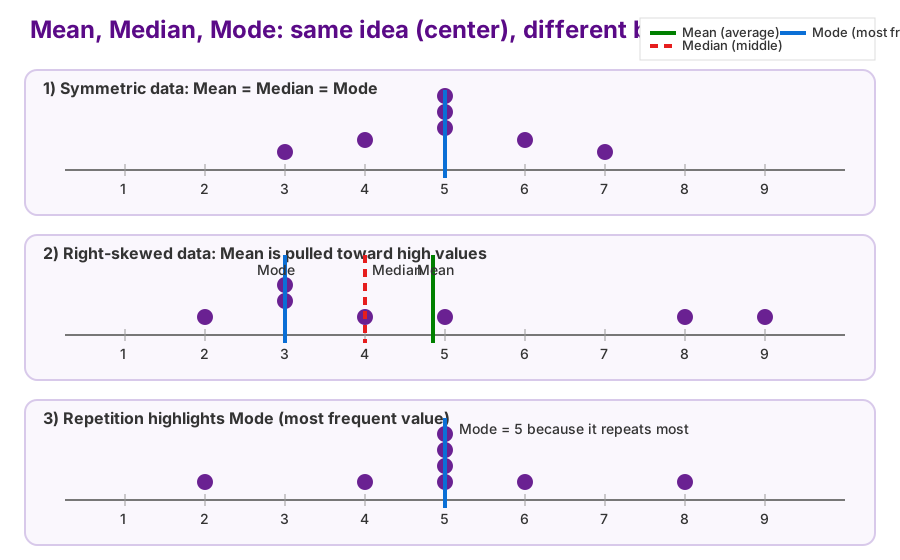
The picture below helps contrast the three ideas. Notice how the mean can shift when extreme values appear, while the median stays at the middle position, and the mode depends on repetition.
Example dataset: 2, 4, 4, 4, 5, 5, 7, 9
- Mean =
(2 + 4 + 4 + 4 + 5 + 5 + 7 + 9) / 8 = 40 / 8 = 5 - Median =
average of 4th and 5th values = (4 + 5) / 2 = 4.5 - Mode =
most frequent value = 4
So, mean, median, and mode each describe the center in a different way. They answer the question: "What is a typical value?"
MAD
(Mean Absolute Deviation)
MAD is a measure of dispersion. It tells us how far values are spread out from the mean on average.
Definition: Take each value, subtract the mean, use the absolute value (ignore + or - sign), and then find the average of those absolute differences.
So MAD does not tell us the center. It tells us how tightly or loosely the data sits around the mean. Smaller MAD means values stay closer to the mean; larger MAD means values are more spread out.
Formula idea: MAD = Average of |value - mean|
Using the same dataset:
2, 4, 4, 4, 5, 5, 7, 9 (mean = 5)
- |2 - 5| = 3
- |4 - 5| = 1
- |4 - 5| = 1
- |4 - 5| = 1
- |5 - 5| = 0
- |5 - 5| = 0
- |7 - 5| = 2
- |9 - 5| = 4
Sum of absolute deviations =
3 + 1 + 1 + 1 + 0 + 0 + 2 + 4 = 12
MAD = 12 / 8 = 1.5
This means the values are, on average, 1.5 units away from the mean.
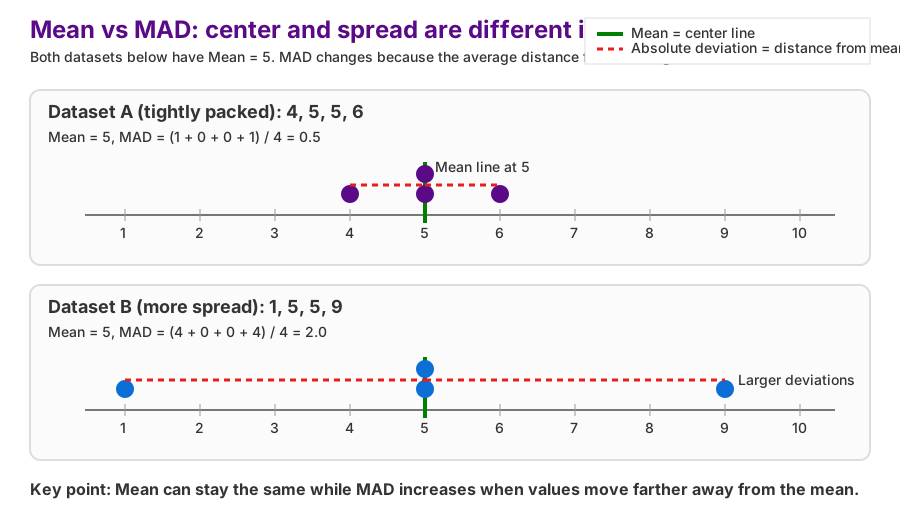
The diagram below compares two datasets with the same mean but different MAD. This is the clearest way to see the difference between mean (center) and MAD (spread).