Loops or Iterations
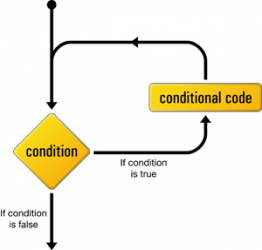
Loops are one of the primary structures without which almost any kind of iterative programme can be written. These structures primarily help, in doing the same job again and again for a given number of times or until the said condition is satisfied (either TRUE or FALSE). For example: to get numbers from 1 to 100, ideally we have to write a statement like print 1, print 2, print 3... print 100 (a hundred number of times) where as with a loop, the program, runs for 100 times, to print the same statement.
Loops are generally classified into different categories as shown in the above diagram.
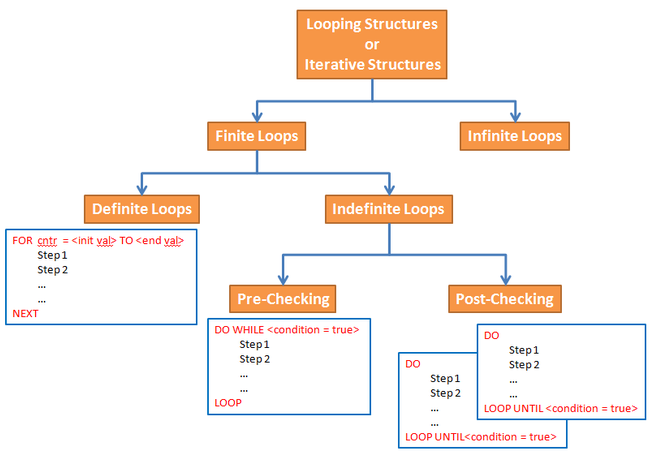
All the given looping structures may not exist in all programming languages, but certainly LOOPS will. Almost any programming language will support, atleast one Definite structure, atleast one pre-checking looping structure and atleast one post-checking structure . I hope these are self explanatory, but still for the benefit of beginner, I will try to explain to some extent.
Components of Loop
Every Finate Loop should ideally have an Initial Value, Counter/Increment Variable and End Value.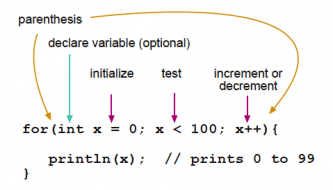
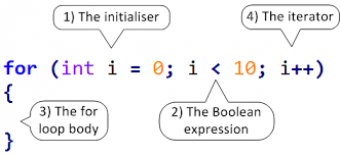
- Initial value is where the programme starts working/counting, or the variable in which the initial value of the loop is stored.
- Counter varaiable starts counting the number of iterations,
- Increment variable steps up the loop,
- The default incremental value of any loop is 1 (one). For example, to count all odd numbers, start the loop with 1 (set the initial value to be 1) and increment the value by 2
- End Value stops the iteration.
Infinite Loops or Iterations
These Loops, certainly, will have a starting point, and hence they start at a certain value but, because they donot have a stop value, the loop goes on. They never stop at any point of time, no matter, the how many number of times the loop may be executed.Hence appropriately named as Infinate Loops. These loops are not generally used in any practical situation. So, this type of loops are considered as logic errors
Though a loop may iterate a million times, but still that million is the end point and hence cannot be considered as infinite loop. Which ideally means, a loop goes on iterating until the user stops intermittently.
Finite Loops
These loops does a certain number of iterations (repeats the same code). We cannot tell as to how many iterations does it iterate., but certainly, it starts at one point and ends at another point. Some times, the start and stop values may be the same.Definite Loops
These kind of loops have a definite start value and a definite stop value. Considering the case of FOR loop, it has a definite start value and a stop value. If there be any need to stop in between, we use EXIT FOR statement to close the loop or exit the loopfor Example
in a FOR loop, start value is 1 (one) increment value is one (it is by default taken as 1) and the end value is 10, in second example, start value is 1, increment value is 2, end value is 10. Therefore, this loop is called DEFINITE loop, hence it is obviously a FINATE loop.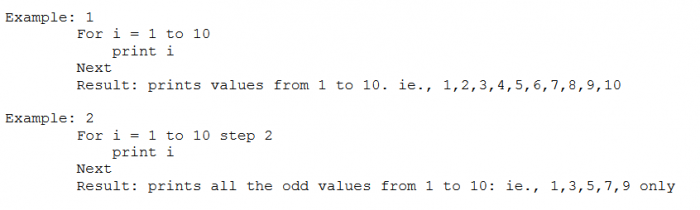
InDefinite Loops
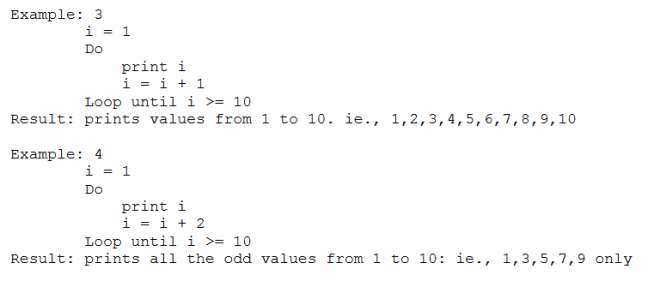
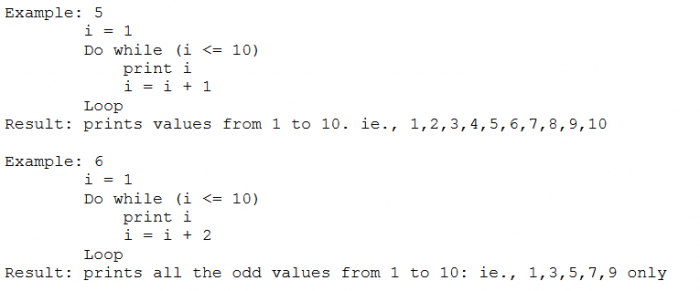
These kind of loops have a definite start value but indefinite stop value. Considering the case of FOR loop, it has a definite start value and a stop value. If there be any need to stop in between, we use EXIT statement to close the loop or exit the loop Considering the above example, with the following structure -examples 3 and 4 for Post-Checking and examples 5 and 6 for Pre-Checking
Note: in examples 3 and 4, as given below, the loop (code between DO and LOOP) does run atleast once before it come to validate initial value
Note: in examples 5 and 6, as given below, the loop (code between DO and LOOP) doesnot runs atleast once before it comes to validate initial value
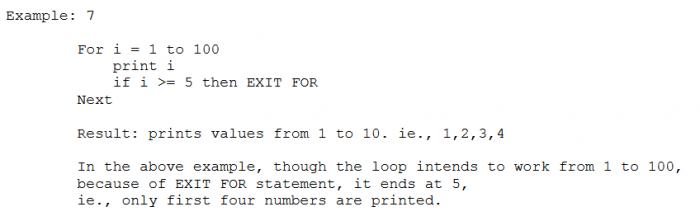
To stop execution of loop in the middle of the programme, or to break the looop, after a certain condition is met, Programming construct provides with Exit For for For Loop, Exit for other loops, when the program executor (either compiler or interpretor) find this statement, the loop stops working and moves to NEXT in case of FOR Loop and End Do in case of Do..While loop
- This means, the lines of code after EXIT statement and NEXT statement are not executed.
- These EXIT LOOP statements are generally used with IF Condition
to Summarise
We need to consider an example, as to how, we can apply this functionality.Consider a database, where you have 'n' number records where the value of n may be 0 (i.e., no records) or 100 records or 1000 records, so, the value of n varies on the number of records a database has.
Now, if I make use of FOR loop where it starts with 1 (i.e., the first record) and ends with 100, the loop may fail when the database has more than 100 records. This is because, by definition: a FOR loop, should have a defined start and stop values, whereas the rest are not so.
to put it in one line: with a START value and a STOP value, FOR Loop is the best, in all other situations, DO WHILE or DO UNTIL can be used
Examples for Practice:
The following examples can be used in programming... Please practice all the examples
with all types of loops available eg: For Loop, Do..While Loop, Do..Until Loop etc... (one Definite
Loop and Two pre-checking types and two post-checking types). Observe the difference, while they are
being executed and in output.
Programming Loops
(Nearly 80 Unique Questions)
This list comprises questions related to different types of looping structures in programming.
Definite Loops (e.g., For Loops)
- Explain the primary components of a standard `for` loop (initialization, condition, and iteration).
- How would you use a `for` loop to print the numbers from 1 to 100?
- Write a `for` loop to calculate the factorial of a given integer $N$.
- What is a **nested loop**, and how are they commonly used with arrays or matrices?
- Demonstrate how to iterate over the elements of a fixed-size array using a `for` loop.
- How can you use a `for` loop to calculate the sum of the first $N$ natural numbers?
- Describe the difference between a traditional index-based `for` loop and a **for-each** loop.
- Write a loop that prints only the even numbers between 50 and 100.
- How do you use the `step` or increment value in a `for` loop to count backward from 20 to 1?
- What happens if the initialization part of a `for` loop is omitted (if allowed by the language)?
- Create a pattern using nested `for` loops (e.g., a simple square of asterisks).
- Explain loop **unrolling** and why it might be used with definite loops.
- How many times does the body of the loop `for (i = 0; i < 5; i += 2)` execute?
- Write a `for` loop to traverse a string and count the number of vowels.
- How can a `for` loop be used to implement the **Fibonacci sequence** up to the $10^{th}$ term?
- What is the function of the **loop control variable** in a definite loop?
- Design a nested loop structure to print a multiplication table (1 to 10).
- If a `break` statement is inside a nested loop, which loop does it exit?
- How is a definite loop typically used when working with collections or lists?
- Write a loop to calculate $X$ raised to the power of $Y$.
- Can the iteration expression in a `for` loop be a decrement instead of an increment? Give an example.
- What is the time complexity of a single `for` loop that iterates $N$ times?
- How do you handle floating-point iteration in a `for` loop, and what are the potential pitfalls?
- Write a loop to search for a specific value in an array and stop when found.
- How can you skip the current iteration of a `for` loop without exiting the loop entirely? (Hint: `continue`)
- What is the maximum number of times a loop defined as `for (i = 0; i < 0; i++)` will execute?
- Demonstrate how a `for` loop can be used to reverse the elements of an array in place.
- Explain why `for` loops are generally preferred over `while` loops when the number of iterations is known beforehand.
- Write a `for` loop that prints every third number starting from 3 and ending at 30.
- What is the scope of the loop control variable when declared within the `for` loop header?
Indefinite Loops (e.g., While/Do-While Loops)
- What is the fundamental difference between a `while` loop and a `for` loop?
- Under what circumstances is a `while` loop a better choice than a `for` loop?
- Explain the concept of a **sentinel-controlled loop** using a `while` structure.
- What is the guarantee provided by a **`do-while` loop** that a standard `while` loop does not offer?
- Write a `while` loop that takes user input until the user enters the word "quit".
- How would you structure a `while` loop to ensure a user enters a positive integer before proceeding?
- What is the **loop invariant** in the context of a `while` loop?
- Demonstrate a `while` loop used to process the elements of a linked list until the end node is reached.
- Explain the concept of **pre-test** and **post-test** loops, giving an example of each.
- Write a `do-while` loop that performs an operation and then asks the user if they wish to repeat it.
- How is the termination condition for a `while` loop typically evaluated?
- What happens if the condition of a `while` loop is initially false?
- Can you convert any `for` loop into an equivalent `while` loop? If so, explain how.
- Describe a scenario where a `while` loop might be used to simulate a timer or delay.
- What is a common error programmers make when using a `while` loop (related to incrementing/decrementing)?
- Write a `while` loop that repeatedly divides an integer $N$ by 2 until it is less than 1.
- How can a `while` loop be used to read data from a file one line at a time until the **End-Of-File (EOF)** marker is reached?
- Why must the initialization of the counter/variable happen *before* a `while` loop?
- Explain why `while` loops are often used in game development for the **main game loop**.
- Write a `while` loop to count the number of digits in a given integer.
- What is the importance of ensuring the loop control variable is modified *within* the `while` loop body?
- Describe the output of a `do-while` loop where the condition is always false.
- In a `while` loop, how can you exit the loop early based on a condition inside the loop body?
- How is **GOTO** statement (if available in a language) different from using a `break` within a loop?
- Write a `while` loop that finds the greatest common divisor (GCD) of two numbers using the Euclidean algorithm.
- Explain the concept of a **flag variable** and how it is often used to control an indefinite loop.
- What is the purpose of the semicolon after the condition in a `do-while` loop?
- How does the execution flow differ between a `while` loop and a `do-while` loop when the condition is true?
- In a language that supports both, when would a `while(true)` structure with an internal `break` be preferred over a simple `while` loop?
- Write a `while` loop to check if a given number is a **palindrome**.
Finite Loops (General/Conceptual)
- Define a **finite loop** in simple terms.
- Is a `for` loop that iterates 1,000,000 times considered finite or infinite? Justify your answer.
- What is the importance of a **loop termination condition** for guaranteeing a finite loop?
- Give an example of a finite loop that involves user interaction.
- Explain how a loop iterating over all elements of a finite data structure (like an array) ensures finiteness.
- Could a `while` loop be considered a finite loop? If so, when?
- What is **convergence** in numerical algorithms, and how does it relate to finite loops?
- Describe a scenario where a definite loop (like `for`) might unexpectedly become a very long, but still finite, loop.
- If a loop's condition depends on a random event, is it still considered a finite loop? Explain.
- What is **resource exhaustion** and how can a finite loop still lead to temporary program issues if the iteration count is too high?
- How does the **maximum integer value** in a programming language impose a theoretical limit on the length of a finite loop?
- Explain the concept of a **timeout mechanism** and how it can convert a potentially long indefinite loop into a finite one.
- Is a recursive function that is guaranteed to stop equivalent to a finite loop? Why or why not?
- Name one common programming task that almost always requires a finite loop structure.
- If a loop condition is `while (x != 10.0)` using floating-point numbers, why might it lead to an *effectively* infinite loop (though theoretically finite)?
Infinite Loops
- Provide the simplest possible example of an **unintentional infinite loop** using a `while` structure.
- What is the primary difference between a **controlled infinite loop** and an unintentional infinite loop?
- Describe a real-world programming scenario (e.g., an operating system or server) where an **intentional infinite loop** is necessary and desirable.